What knowledge shapes your data?

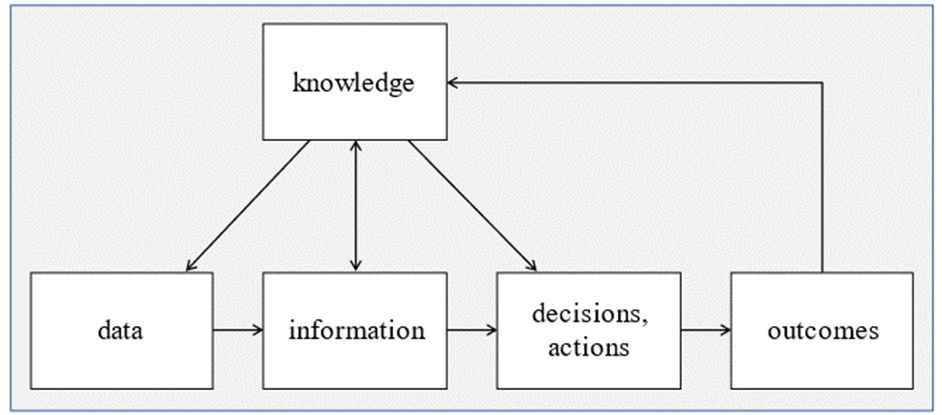
Managing knowledge effectively is key to achieving your organisation's objectives. The conventional view is that you start with data - i.e., the basic raw facts. This data is then sorted, analysed, and contextualised to create information. This information is then used to guide decisions and actions that lead to outcomes. These outcomes then inform learning, which develops knowledge.
However, reality is more complex than that. The number of basic raw facts in existence is practically infinite. To be able to identify the ones that actually matter to your organisation's objectives you need to have prior knowledge. You also need prior knowledge to be able to sort, analyse, and contextualise that data into information that is useful for decision making. Moreover, you need prior knowledge to use the information for decision making - and to determine what should be learned from the outcomes.
It is important to recognise and reflect on the central role of prior knowledge in creating new knowledge. What/whose knowledge do you start with when you set out to develop a knowledge base to achieve your organisation's goals? Is that the right knowledge? Are you missing key perspectives?
Data should play an important role in decision making, but calling actions "data-driven" is a misnomer. It obscures the main factor that determines whether your approach to knowledge management will help your organisation achieve its intended goals.